Ho-Ho-Kus
Just One LookHo-Ho-Kus is the New Jersey suburban setting of the Freddy Sykes episode and a crucial part of Eric Wu’s plan: its quiet residential layout offers privacy for his crimes, while its closeness to the Lawson residence makes it strategically useful. The same streets that help him move unseen also give Charlaine Swain a view of suspicious activity and, eventually, a route by which the pursuit can follow him.
Setting and suburban geography
Freddy Sykes lives in Ho-Ho-Kus, only three miles from the Lawson residence. That distance matters to Wu, who needs a victim geographically close to the household he is monitoring. He selects Sykes not only because he is isolated from family and close friends, but also because his home provides a convenient base within the area Wu needs to move through.
The neighborhood around Sykes’s house is described as a block of similar-looking homes, mostly occupied by young families who pay little attention to him. Its ordinariness helps conceal a crime: Sykes’s house looks like its neighbors, and the people living nearby do not know enough about him to make his private life visible. Ho-Ho-Kus is not presented as a place of dramatic landmarks; its repeated houses and everyday routines are precisely what let Wu blend his activity into the background.
The layout also has a practical, more unsettling dimension. Sykes’s garage is attached to the house and opens electronically, allowing someone to enter or leave by car without being seen from the street. Wu regards this arrangement as useful. The home’s ordinary suburban convenience becomes a form of cover, letting him control access and move between the house and a vehicle with less public exposure.
Sykes’s house and Wu’s operations
Wu’s choice of Sykes connects the town’s social isolation to his method. Sykes is forty-eight, works for a storefront tax-filing company in Waldwick, and has no surviving parents or siblings. After caring for his mother, he inherited the Ho-Ho-Kus house. Wu learns from Sykes’s online flirtations that he has had little opportunity for a relationship, then uses a fabricated online identity and a borrowed photograph to cultivate his trust. The house’s proximity to the Lawson residence makes this carefully selected victim useful to Wu’s larger purpose.
After Rocky Conwell interferes, Ho-Ho-Kus becomes a staging point for Wu’s efforts to conceal both a body and a vehicle. He places Conwell in the trunk of his Toyota Celica, transfers Jack Lawson from the Honda Accord into the Ford Windstar, changes the Windstar’s plates, and removes its E-ZPass. He returns the van to Sykes’s garage, where it can be kept out of sight, then takes Conwell’s car to the Route 17 Park-n-Ride and leaves it in a remote spot near the fence. That lot is also three miles from Sykes’s house, close enough for Wu to walk back.
The house and the surrounding transport routes serve different parts of the same operation. Wu can leave the Windstar concealed in the garage, travel by bus to Central Valley, and return the following morning to retrieve Sykes’s Honda Accord. On the drive back, he detours past the Lawson residence and sees a patrol car in the driveway. The sequence makes Ho-Ho-Kus both a refuge for concealed vehicles and a point from which Wu checks the police presence around the family he is targeting.
Charlaine Swain’s view of the neighborhood
The same residential setting that gives Wu cover also gives Charlaine Swain a view into Sykes’s garage. From her house, she sees a light come on and a shadow moving inside. She knows there should be no reason for the responding officer to be in the garage, and that discrepancy changes her response: she calls 911 again and begins moving downstairs. The incident turns an ordinary neighbor’s window into a vantage point on a crime unfolding close by.
Charlaine’s first call has brought a lone officer, whose relaxed manner makes her uneasy. She worries that she had described the situation too casually and that the officer has arrived unprepared. In the neighborhood’s familiar domestic setting, a possible break-in can be treated as routine; that apparent normality is exactly what Wu uses when he meets the officer at the door and offers an explanation for being there. Charlaine’s second call follows what she sees, rather than the reassuring appearance Wu presents from the front of the house.
Her growing alarm also takes place against the isolation of home life. The Swains’ children are away, Mike is watching television downstairs, and the couple occupy separate rooms and spend the evening apart. Charlaine’s attention to the neighboring garage pierces that private routine. When she later tells Mike what has happened, she leaves out why she had been looking out the window in the first place; the account she gives him contains an omission, even as the danger outside draws them into shared action.
Roads, pursuit, and narrative significance
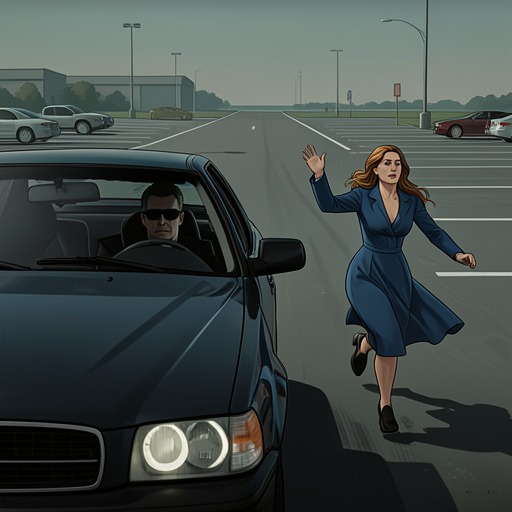
Ho-Ho-Kus’s street plan becomes important when Mike drives after Wu. In this stretch of the town, the twisting development of cul-de-sacs, tract houses, and wooded lots has only one true entrance and exit road. The roads lead to Hollywood Avenue, giving the Swains a specific route on which to pursue a man who has already gained a head start. The same winding design that can make a neighborhood feel secluded also concentrates movement onto a limited way out.
Ho-Ho-Kus therefore shapes the episode through a contrast between concealment and observation. Similar houses, private garages, and neighbors who pay little attention allow Wu to operate discreetly. Yet Charlaine’s window, a police response, and the town’s constrained road network create opportunities for suspicion and pursuit. The location is not simply a backdrop to the crimes: its distances, sightlines, and routes help explain both how Wu gains temporary cover and how the Swains begin to close the gap.